Built to see almost everything, except straight ahead
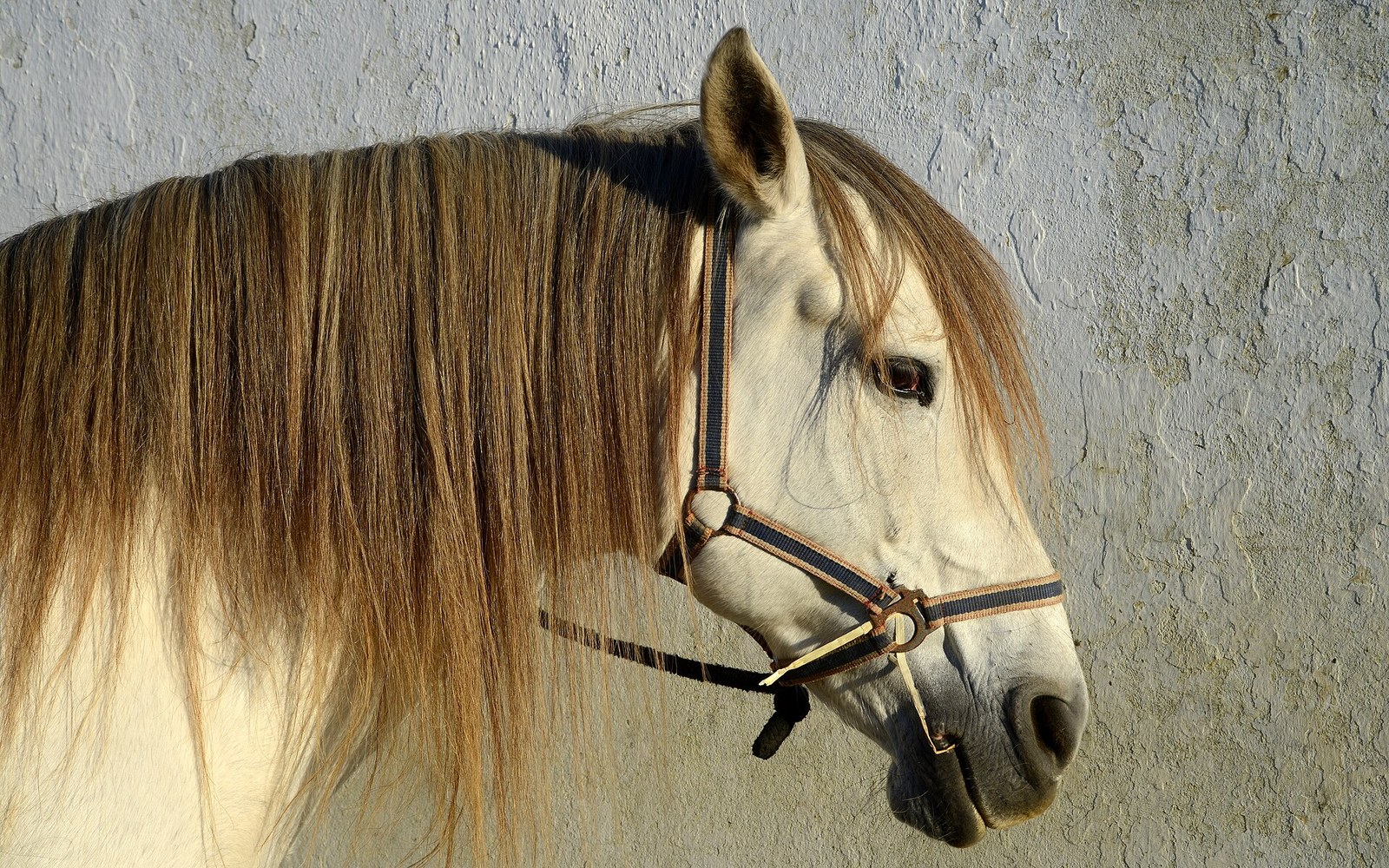
A horse's eyes are positioned for survival, not for looking at you — and the geometry of that placement explains more behaviour than any theory of temperament.
The eye itself, and where it sits
The horse eye is among the largest of any land mammal — roughly the diameter of a golf ball — and it sits on the side of the skull, set back and elevated. That placement is the foundational fact of equine vision, because it is the eye of a prey animal arranged to detect movement at the periphery before a predator can close the distance. Each eye operates largely independently of the other, gathering its own image, which is why flight distance, herd behaviour and what a box stall does to both often pivot on visual triggers that happen well outside the arc a human observer is watching.
The field of view that results from this lateral placement is panoramic to a degree most people find surprising. A horse standing still and looking ahead has monocular vision — each eye working alone — covering a broad arc on each side, and the total visual field sweeps to somewhere between 340 and 350 degrees around the body. A bird flushing from a hedgerow behind and to the left, a dog moving in peripheral darkness on the right: both are detectable without the horse turning its head at all. Evolution built this at a cost, and the cost is specific.
Two zones are blank. One sits directly behind the hindquarters — a narrow column of darkness that runs straight back from the tail. The other, less often discussed, is directly in front of the face. A horse cannot easily see what is immediately before its nose. The blind spot at the rear is widely known among handlers; the frontal one is less appreciated, and it matters more in practice.
The geometry of the frontal blind spot
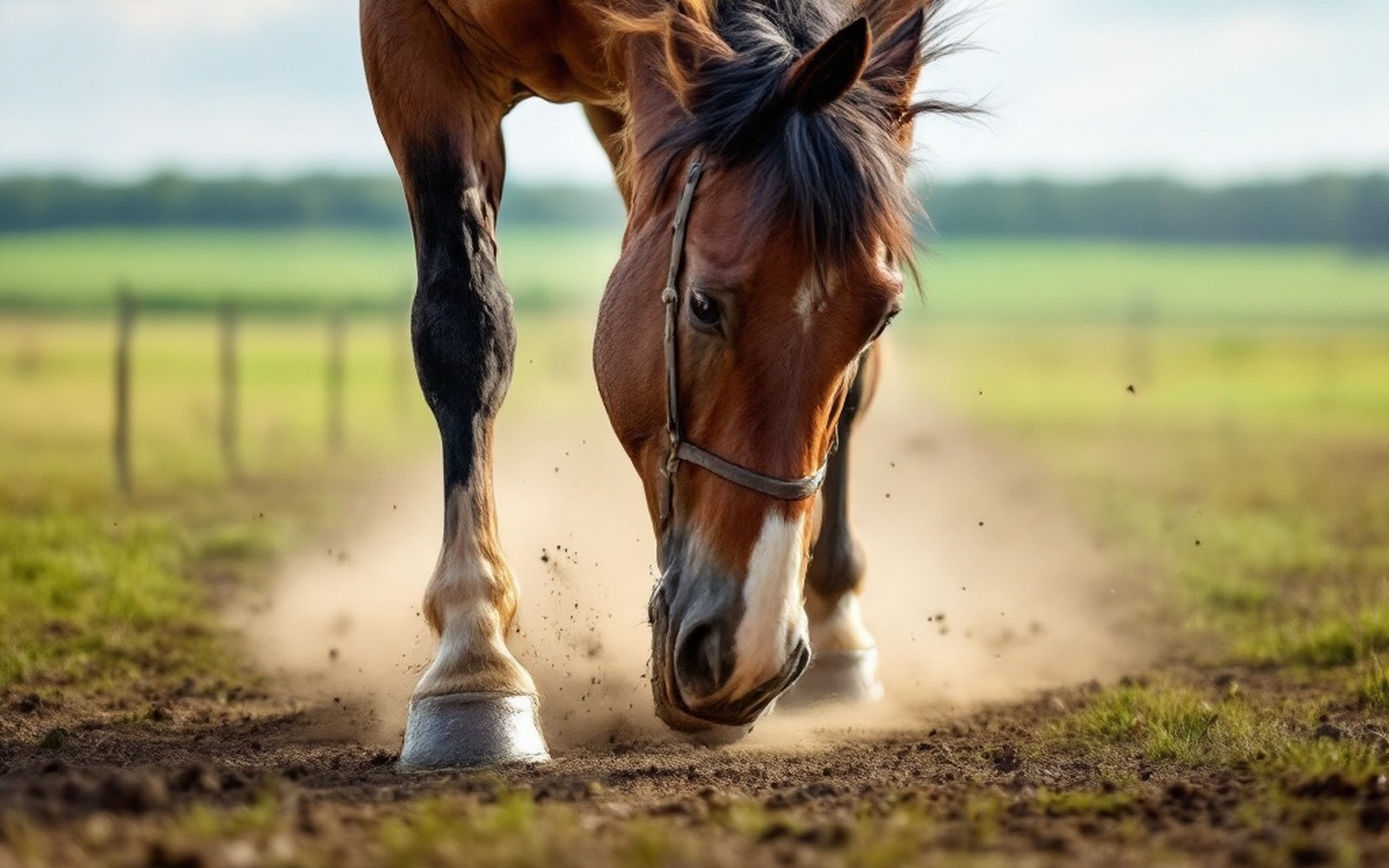
The reason the area directly ahead is difficult to see clearly lies in the angle and spacing of the orbits. The eyes are set so far apart and so far back from the muzzle that the visual fields of each eye meet somewhere out in front of the animal — not right at the nose tip. The zone of binocular overlap, where both eyes contribute to the same image and depth perception becomes possible, is a relatively narrow corridor that extends forward and slightly upward. It sits roughly in front of and above the nose, not below it.
Practical consequence: an object on the ground directly beneath a horse's lowered muzzle — a step, a shadow, a drain cover, a change in footing — drops into the frontal blind zone. The animal must tip its head to one side, using monocular vision from a tilted angle, or extend its neck and bring the object further from the body before it can resolve what it is. Watch a horse encounter a tarpaulin laid flat on the ground, or a painted white line on tarmac, and you will see exactly this sequence of head movements: not disobedience, not stupidity, but an animal doing the visual geometry it was built to do.
The binocular corridor itself is also narrow compared with human stereoscopic vision. Humans have roughly 120 degrees of binocular overlap; the horse's equivalent is estimated at somewhere between 60 and 70 degrees. Within that corridor, depth perception exists and is functionally useful — useful enough, for instance, that a horse approaching a jump will lower its head and use that forward-facing binocular field to judge the take-off point. Riders who have studied this describe horses shortening their necks and looking actively downward a few strides out. The horse is not relaxing; it is ranging.
What this means for the animal's behaviour
The retina of the horse eye is also differently organized from our own. Rather than a concentrated fovea — a small pit of high-density cone receptors that gives humans sharp central vision — the horse has a structure called the visual streak: a horizontal band of higher receptor density running across the mid-retina. This arrangement suits an animal scanning a horizontal landscape, a grassland or steppe, for moving shapes. It is well documented in comparative anatomy and it means the horse has its sharpest resolution not in the centre of its gaze but along a horizontal band — tuned to pick up the low, fast movement of a predator crossing open ground.
The horse's colour vision is dichromatic. Research based on behavioural discrimination tasks and receptor analysis suggests horses can distinguish blues and yellows reliably, while reds and greens are less differentiated — a colour world broadly analogous to that of a human with red-green colour blindness. A bright-orange jacket and a grey one may look broadly similar. A blue arena board and the pale sand behind it should be distinct.
Pupil shape adds another layer. The horse has a horizontally elongated pupil that, like the slit pupil of a cat but oriented differently, controls the amount of light entering across a panoramic field. In bright conditions it narrows to reduce glare across the wide monocular arc; in low light it opens broadly. Research published through comparative vision science has noted that this pupil geometry, shared with many other grazing prey animals, appears to optimize for detecting predators approaching across the horizon under varying light. At dusk, when a horse's large eye gathers light efficiently, the animal may see the environment quite differently from the handler who is squinting to make out the path home.
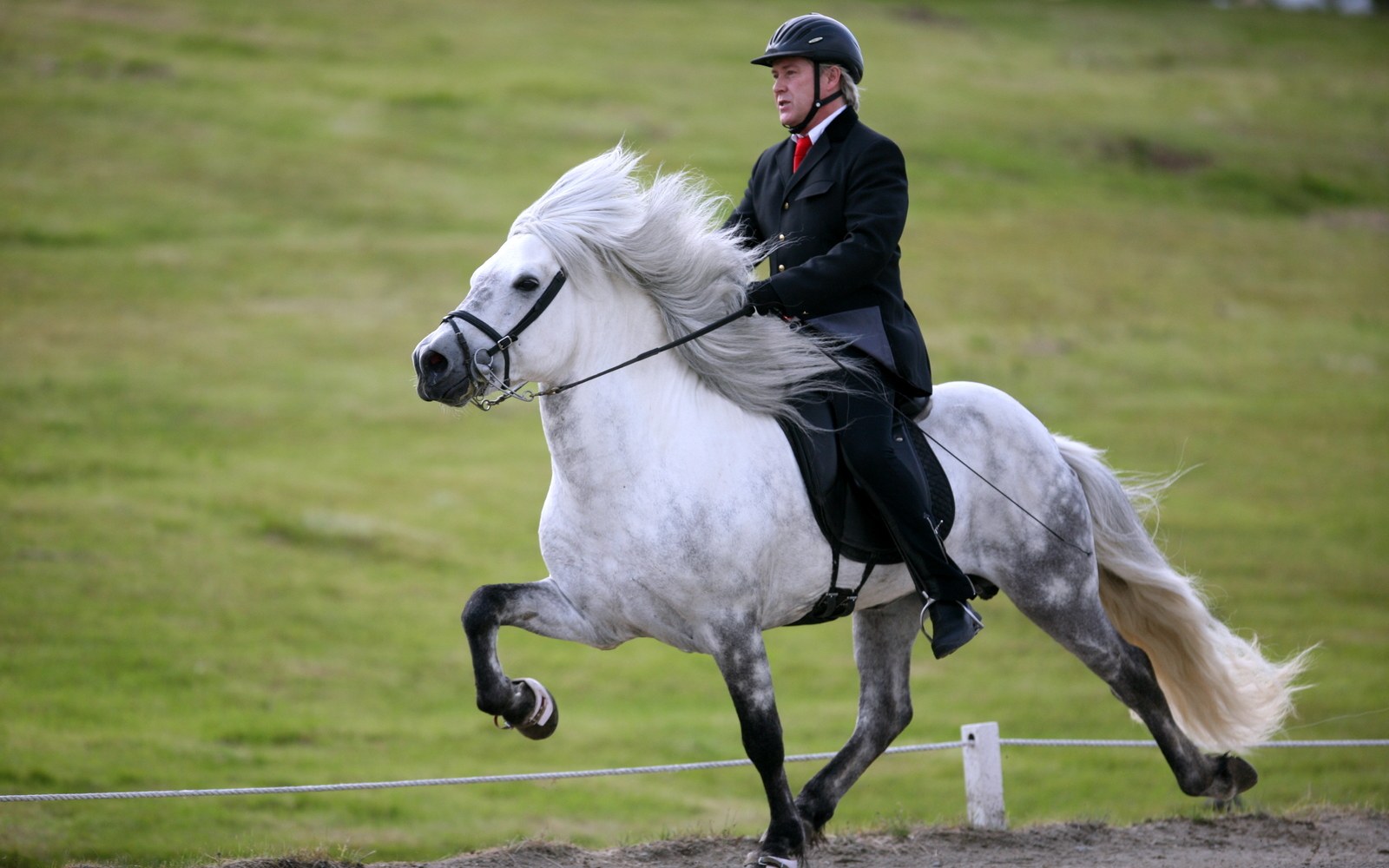
All of which makes the common attribution of shying to "being silly" or "making trouble" a straightforward misreading of anatomy. The horse that throws itself sideways at a plastic bag has seen it as motion in the monocular periphery — a signal evolution coded as dangerous — before any conscious evaluation was possible. The animal that props and stares at a shadow on the ground is using the frontal blind zone as carefully as it can, tilting and stepping to bring the shadow into a workable part of its field. The animal that strikes out behind when approached from the rear is not vicious; it is operating on the correct instinct that the one arc it cannot see is the most dangerous one.
Understanding the optics does not make a horse safer to handle or easier to train. It makes those things possible to understand for what they actually are: the behaviour of an animal whose visual system was shaped for open country and flight, fitted into a world of stables, roads and unexpected objects, and asked to treat none of them as threats.
Read next
- Gaits are footfall, not speedWalk, trot, canter and gallop are defined by the sequence the feet land in, which is why a fast trot is still a trot.
- The ambling gaits, and the gene behind themSome breeds have a lateral four-beat gait others cannot perform, and it is traced to a documented mutation.
- A prey animal in a stableFlight distance, herd behaviour and what a box stall does to both.