The ambling gaits, and the gene behind them
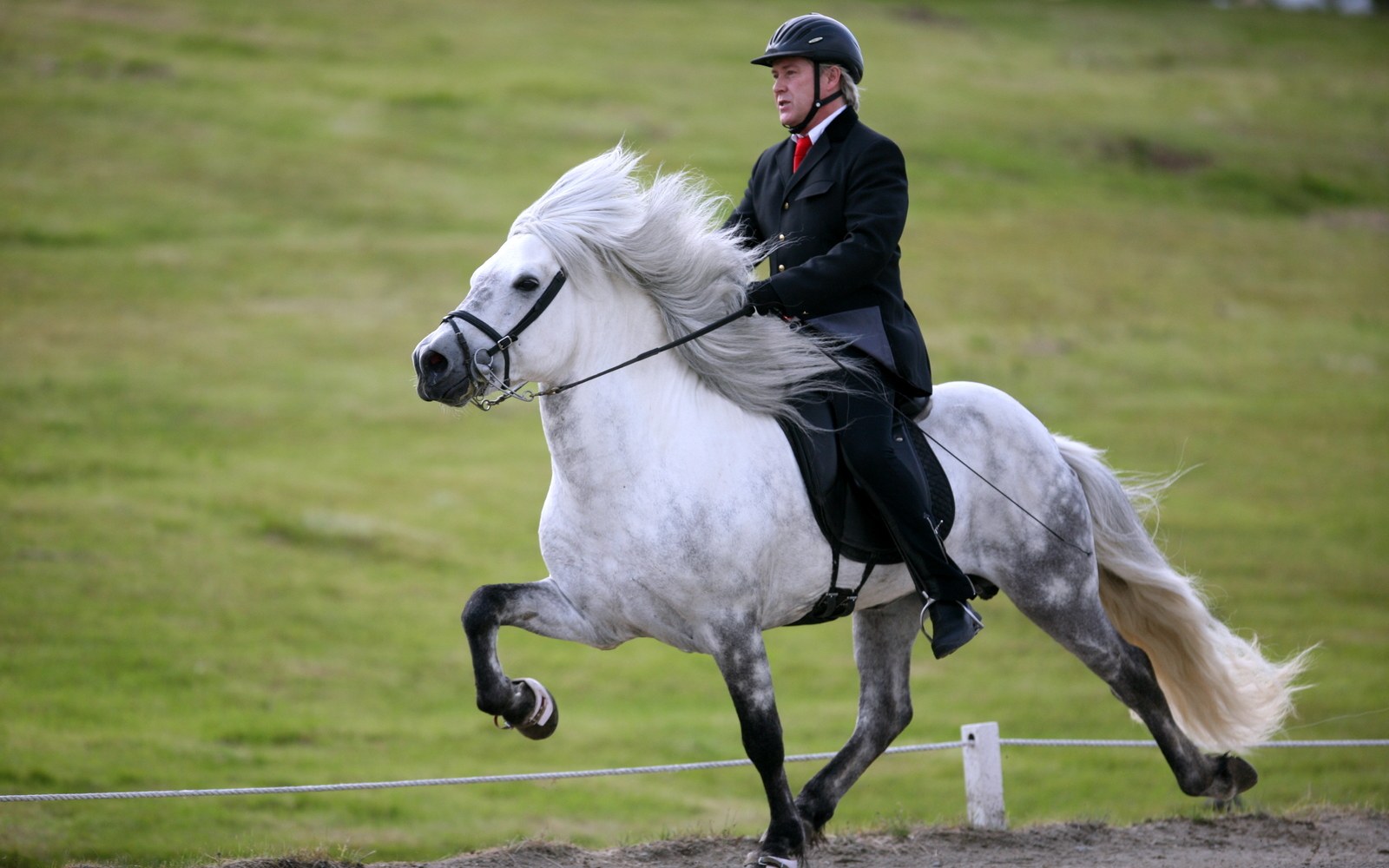
Some horses move in a smooth lateral four-beat rhythm that others cannot perform — and the difference comes down to a single documented mutation.
What an ambling gait actually is
At the walk, a horse moves in a four-beat lateral sequence: left hind, left fore, right hind, right fore. Increase the speed and most horses trot — a diagonal two-beat in which left hind and right fore strike together, then right hind and left fore. A few breeds skip the trot entirely and instead accelerate into a faster four-beat gait that keeps one foot on the ground at almost every moment. The result is a ride with almost none of the vertical bounce a trot delivers to the rider's seat.
These are the ambling gaits, and they go by many names: the tölt of the Icelandic horse, the paso llano of the Paso Fino, the rack of the American Saddlebred, the running walk of its close cousin the Tennessee Walking Horse. Each breed community guards its own terminology, but the underlying footfall pattern is the same lateral four-beat. What varies between them is cadence, collection and the precise moment at which each foot lifts — differences that breeders and judges have spent generations refining, even without understanding the mechanism behind them.
The DMRT3 mutation
In 2012 a research team at Uppsala University published a landmark study identifying a single-nucleotide mutation in the gene DMRT3 — doublesex and mab-3 related transcription factor 3 — as the genetic switch that makes ambling gaits possible. The gene is expressed in spinal interneurons that coordinate limb movement, and the mutation appears to alter the inhibitory circuitry governing how the legs are timed against each other. A horse carrying two copies of the mutant allele (homozygous) has the full lateral range; a horse without it is neurologically constrained to the diagonal patterns of trot and canter.
The Uppsala team, working with a dataset that spanned multiple breeds and continents, found the mutation at high frequency in the gaited breeds they tested and also in harness-racing breeds such as the Standardbred, while it was absent from many other breeds. The study, published in Nature, was the first time a single gene variant had been convincingly linked to a distinct gait type in horses — a finding that bridged two bodies of knowledge, the genetics of spinal circuit development and the centuries-old trade in gaited breeds.
What this means for the breeds
The Icelandic horse is perhaps the clearest example. Isolated in Iceland since medieval times and governed by a closed studbook that prohibits re-importation of horses once exported, the breed has preserved the tölt as an almost universal trait. Because no outside trotting blood has entered, the DMRT3 mutation has remained at very high frequency. In breeds such as the Paso Fino and Peruvian Paso, selective pressure over centuries — long before any genetic explanation existed — achieved the same result, retaining the ambling variant and culling animals that trotted instead.
The Tennessee Walking Horse and the related Rocky Mountain Horse show the same picture. The mutation's distribution maps neatly onto the historical record of which breeds were wanted for comfortable travel over rough country, which is precisely the context in which smooth lateral gaits had practical value: the plantation owner, the mountain postman, the long-distance trail rider all preferred a horse that did not jar them across hours of uneven ground.
Not every horse with the mutation necessarily expresses a finished, cadenced amble — other modifier genes and training shape what the rider actually feels. But without the DMRT3 variant, no amount of selection or work produces the gait at all. The mutation is necessary; it is not, by itself, sufficient.
The gait in time
The ambling gaits have been documented far longer than the gene. Medieval European sources describe amblers as distinct from trotters, and the amble was the preferred gait of royalty and clergy who spent long days in the saddle. By the early modern period the word had become unfashionable in European competition breeding, which tilted toward the trot, and the gait was progressively selected out of the warmblood and Thoroughbred lines that came to dominate sport. It survived in the Americas and Iceland precisely because those contexts never stopped valuing it. The DMRT3 paper at Uppsala is, in a sense, the genetic footnote to a very long agricultural preference.
Read next
- Built to see almost everything, except straight aheadMonocular vision on each side and a blind spot directly in front explain most of what gets read as temperament.
- Gaits are footfall, not speedWalk, trot, canter and gallop are defined by the sequence the feet land in, which is why a fast trot is still a trot.
 A prey animal in a stableFlight distance, herd behaviour and what a box stall does to both.